From Complaint to Commission, The Birth of the Diaconate, Part 1 | November 30, 2025
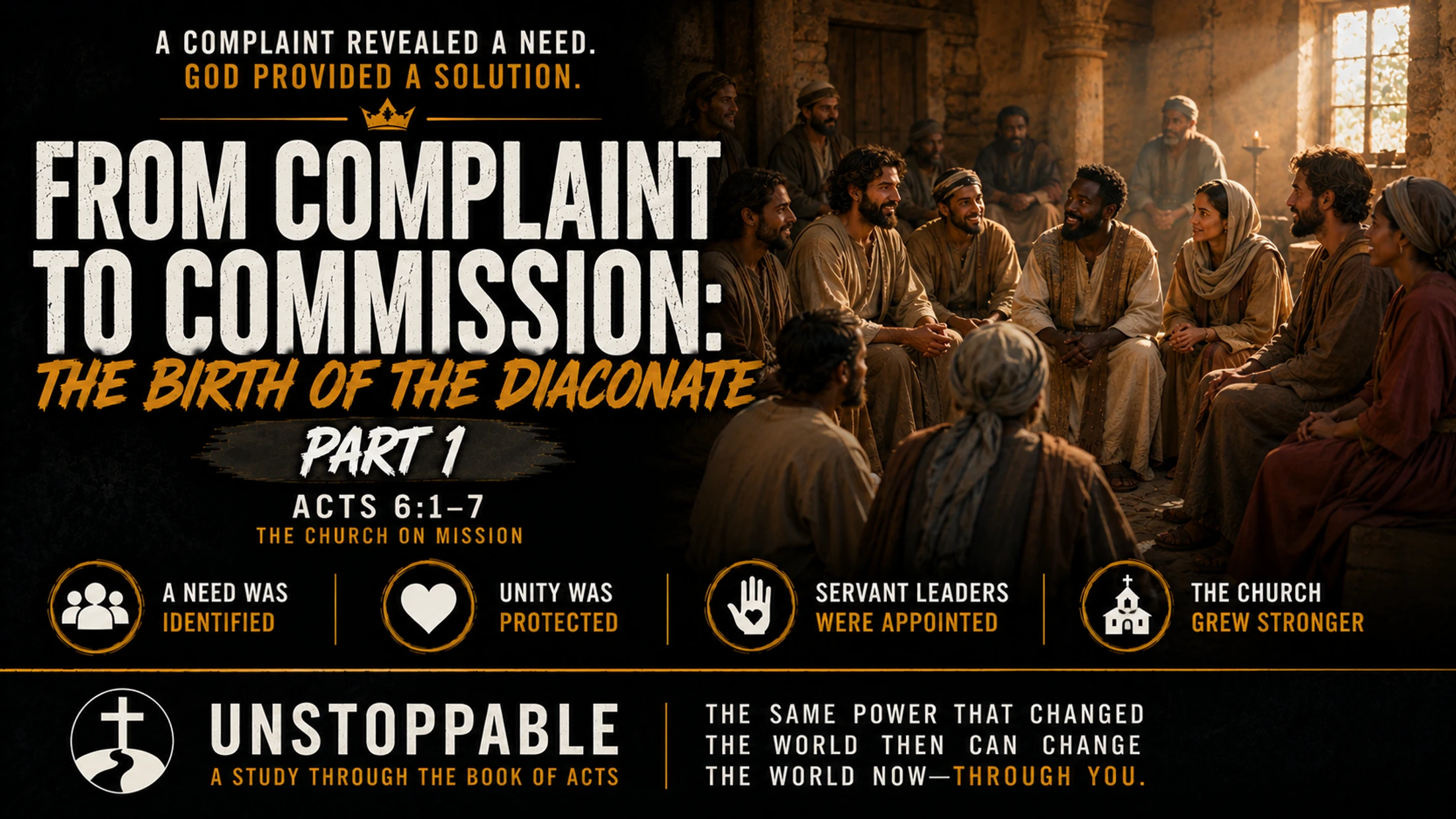
The Setup: A Complaint That Changed the Church
Sermon number fifteen shifted gears into a new season of the series, as Pastor Justin briefly recapped Gamaliel's counsel and the apostles' joyful suffering from the week before, then opened Acts chapter six and introduced what he called the birth of the diaconate, the origin of the office of deacon in the local church. He started simply, defining diaconate from Merriam-Webster as the office of a deacon or deaconess, or the official body of deacons collectively.
The chapter opens with a real complaint in verse one. As the number of disciples was increasing, the Hellenists, meaning Greek speaking Jewish believers, raised a complaint against the Hebrews because their widows were being overlooked in the daily distribution of food. Pastor Justin took real time to explain why this mattered so much, noting that the first century church was bringing together Jews, Samaritans, and Greeks who had every cultural reason, rooted in generations of racial hostility like the tension behind the parable of the Good Samaritan, to remain separate.
He got personal about this same tension inside The Crossings today, sharing that the church's racial makeup genuinely reflects the diversity of Brunswick, and that conservative and liberal members worship side by side because they put Jesus first. He was honest about small missteps along the way too, including a phrase he used to say casually as a teenager that a family in the church found offensive, and how he simply stopped saying it once he learned it caused harm.
That real world tension set up the first truth of the passage, that complaints reveal a church's real gaps. Pastor Justin admitted plainly that as one man, he cannot see or fix every need in the congregation himself, and that hearing a complaint seriously, even one he might not initially agree with, is part of faithfully leading. The apostles' first response in verse two was almost blunt, that it was not right for them to give up preaching the word of God to serve tables, essentially telling the congregation this was not something leadership needed to personally solve.
Their actual solution became the second truth of the message, that the church needs qualified servant leaders. The apostles asked the congregation to select seven men of good repute, full of the Spirit and wisdom, to oversee the daily distribution, freeing the apostles to devote themselves to prayer and the ministry of the word. Pastor Justin was clear that no task is ever beneath a pastor, recalling how he and his family personally cleaned toilets and mopped floors when the church met in its first building.
He then walked through a careful word study distinguishing elder, shepherd, and overseer in the Greek, presbuteros, poimaino, and episkopos, showing from 1 Peter 5:1-2 and Acts 20:17 and 28 that all three terms describe the exact same office used interchangeably by the New Testament writers. He used this groundwork to explain why The Crossings holds the office of elder for men only, while planning to address next week why women can rightly serve as deaconesses, a distinction he wanted to lay out honestly rather than skip past.
Philippians 2:1-11 gave the passage its theological anchor, Christ Himself, who though He was in the form of God did not count equality with God a thing to be grasped, but emptied Himself and took the form of a servant. Pastor Justin tied the whole message back to that humility, that both elders and deacons exist not for status or power but to serve a church that reflects the self emptying posture of Jesus.
This Week's Application
So this week, wherever you serve or hope to serve in this church, will you examine your own heart and motives honestly before God, asking Him to search you the way only He can? We would love for you to join us this Sunday as we continue this conversation together.