Radical Generosity, Giving What God Gave First | September 14, 2025
The Setup: A Church That Shared Everything
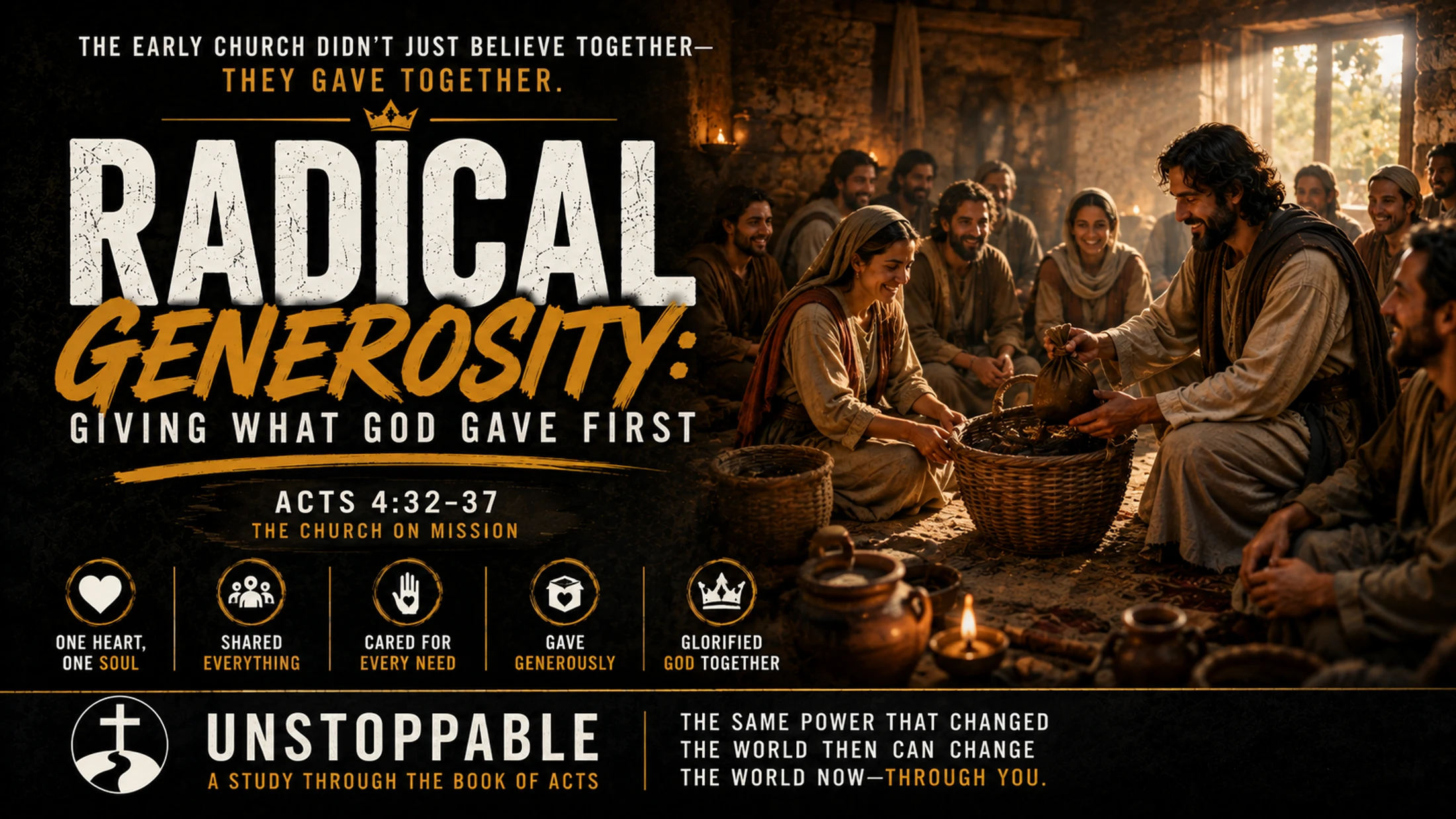
Sermon number ten turned from boldness to money, and Pastor Justin walked us through Acts 4:32-37 to show how radically different the first century church's approach to possessions was from our modern American instincts. Luke tells us the believers were of one heart and soul, and that no one considered anything he owned to be his own, so much so that those who owned land or houses sold them and laid the proceeds at the apostles' feet so there was not a needy person among them.
Barnabas gets singled out by name in this passage, selling a field and bringing the money to be distributed to whoever had need. Pastor Justin shared his own story from early in his faith, when his car was stolen and the church came together to buy him a beat up 1970s Ford LTD, and how neighborhood teenagers soon started asking him for rides to church, a request he could never turn down because, as he put it, it was not his car, it was God's car.
That personal story set up the theological foundation for the entire message, Psalm 24:1, that the earth is the Lord's and everything in it. Nothing we hold, our homes, our income, our savings, actually originates with us. Pastor Justin explained that to steward something means to guard or administer property that belongs to someone else, and once a believer really grasps that everything already belongs to God, radical generosity stops looking radical and starts looking obvious.
That gave us the first point of the morning, that we are stewarding what belongs to God, not managing our own private wealth. Pastor Justin was honest that unity around a church's vision often breaks down right at the point of the offering plate, when people who are fully on board with a church's mission suddenly go quiet as soon as they are asked to give financially toward it, a telling sign of whose money they still believe it is.
The second point contrasted the early church's giving with the Old Testament tithing system, where every Jewish person was required to give ten percent of their firstfruits to the temple and priests. Pastor Justin pointed out that nowhere does the New Testament require this kind of legalistic percentage from Christians, and instead uses 1 Corinthians 9:1-14, where Paul defends a pastor's right to be supported by the gospel he preaches, to show that New Testament giving is meant to be sacrificial rather than a fixed legal obligation.
He was transparent about his own situation, sharing that he and his wife Maggie had already fundraised his entire salary for the next three years, meaning every dollar given at The Crossings goes directly into ministry in Brunswick and the surrounding area rather than his paycheck. That transparency set up the third point, that giving unites the church and advances the kingdom, because Matthew 6:19-21 reminds us that wherever our treasure is, that is where our heart will be also.
Pastor Justin closed with a brief history of how the church, not the government, was originally responsible for caring for the poor, the sick, the widowed, and the orphaned throughout most of Western history, a role that shifted to government welfare programs only in the last few centuries. He was careful to say this was not a knock on people who use those services, since he grew up on food stamps himself, but a challenge to the church to reclaim tangible, real world care for its neighbors funded by radically generous giving.
This Week's Application
So this week, take an honest look at how you view what God has entrusted to you. Do you see it as yours to manage as you see fit, or as His to steward faithfully and sacrificially for the sake of others? We would love for you to join us this Sunday as we continue walking through Acts together.