Through Many Tribulations: The Road Back | August 2, 2026
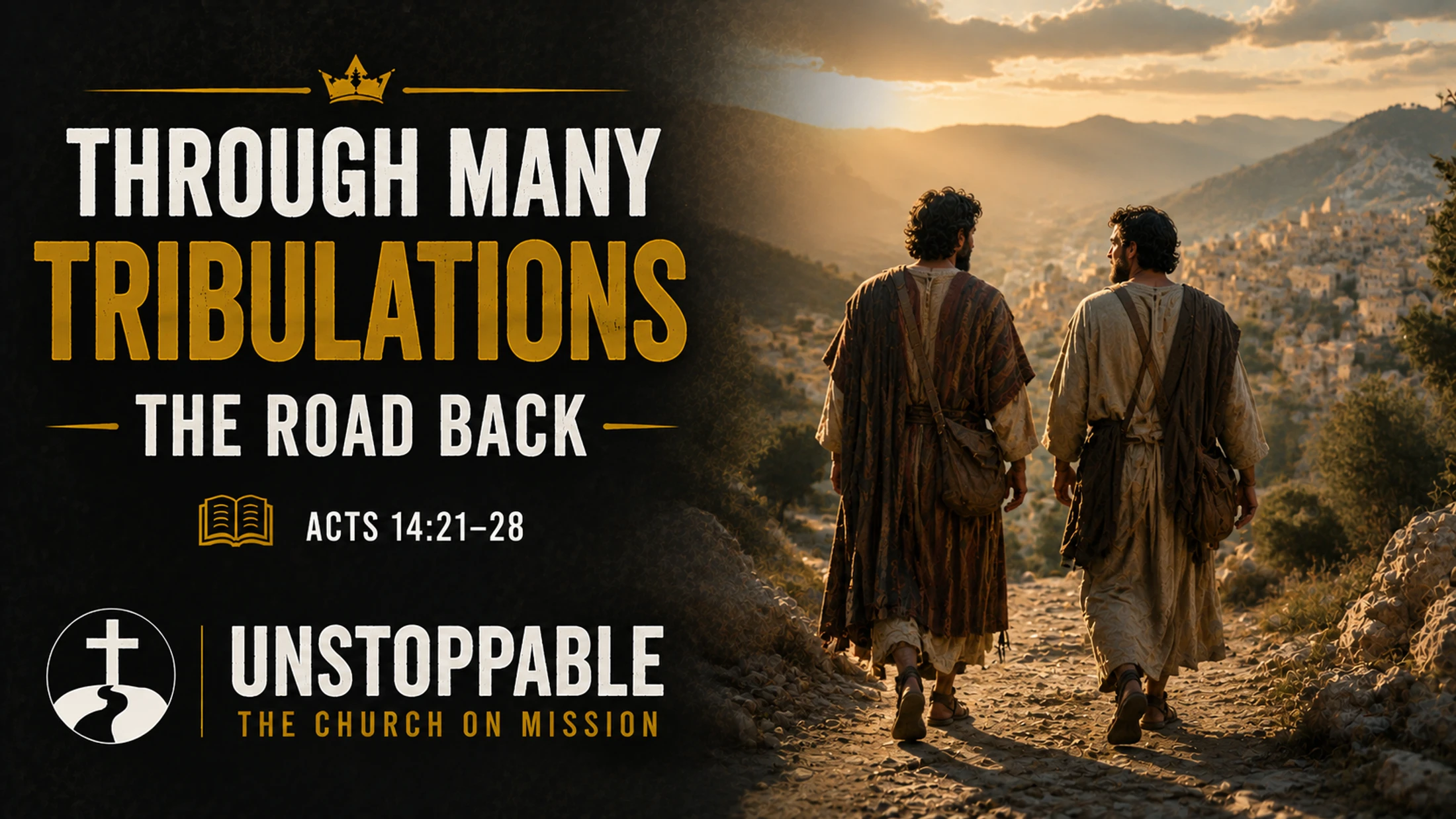
The Setup: Beaten, Left for Dead, and Walking Back In
This week in our Unstoppable series through the book of Acts, we picked up right where we left Paul the week before, bloody in the dirt outside the city of Lystra, stoned and left for dead. Sermon 39 finds him and Barnabas doing something none of us would expect. In Acts 14:21-28, after being run out of town, beaten, and abandoned in the street, Paul and Barnabas turn around and walk straight back into the towns that tried to kill them. If you missed Sunday, or you were there and want to sit with it a little longer, here is where we landed.
Our first point was simple and hard at the same time. The Christian life is marked by tribulation, and there is no way around it. Acts 14:22 tells us that Paul and Barnabas went about strengthening the souls of the disciples, encouraging them to continue in the faith, and saying that through many tribulations we must enter the kingdom of God. That word must is not a maybe. In the Greek it is the word dei, the same weight Jesus used when he told his disciples that the Son of Man must suffer. Paul is not warning these young believers that hardship might show up if they are unlucky. He is telling them tribulation is the road itself.
We were careful on Sunday to say what this does not mean. It does not mean suffering is punishment, and it does not mean the more you suffer the closer you are to God. This is not an excuse to live in misery because you believe pain earns you favor. Tribulation is not evidence God left you, and it is not a merit badge either. We saw this same pattern all the way back in the wilderness. Deuteronomy 8:2-3 tells us God led Israel through the desert for forty years that he might humble you, testing you to know what was in your heart, whether you would keep his commandments or not. God was not scoring how much pain Israel could absorb. He was teaching an entire generation that they could not survive on bread alone.
We also looked at Romans 8:17-18, where Paul writes that we are heirs of God and fellow heirs with Christ, provided we suffer with him in order that we may also be glorified with him. Glory and suffering are stitched together in the Christian story, whether we like that or not. We told the story of Elisabeth Elliot, whose husband Jim and four other missionaries were speared to death by the Waodani people in Ecuador in January of 1956. Two years later, Elisabeth packed up her three year old daughter and went to go live with the very tribe that killed her husband. She learned their language, lived in their homes, and eventually watched some of the men who threw those spears give their lives to Jesus. One of them later baptized Nate Saints own children, Nate being one of the five men his hands had helped kill. That is the road. Not around the tribulation. Through it.
Our second point moved from suffering to succession. Paul and Barnabas appointed elders in every church before they moved on to the next town. The Greek word behind appointed, cheirotoneo, literally means to stretch out the hand, and we were honest on Sunday that the text does not fully resolve whether these churches voted on their elders or whether Paul and Barnabas simply chose them. What the text does make clear is that these men were not just handed a title. They were entrusted, on their knees, in prayer and fasting, to the Lord himself. Paul gives the same instruction later to a young pastor named Titus, in Titus 1:5, to appoint elders in every town he was sent to.
A mission that depends on one person is not a mission, it is a bottleneck. We talked about a simple test for anyone who leads anything, a family, a small group, a business, a ministry. If you disappeared tomorrow, would it survive? Not would people miss you, of course they would, but would the thing you built keep going? This church runs because people show up early to set up chairs, plan worship, greet visitors, and check on teenagers nobody else is watching. None of that depends on any one person. We talked about a principle worth carrying into every area of life, that if someone wants to take something off your plate and they can do it at least eighty percent as well as you, let them. Do not hide behind false humility. Do not steal that blessing from them.
Our third and final point turned from the labor to the credit. When Paul and Barnabas finally reported back to their sending church in Antioch, Luke tells us they declared all that God had done with them, and how he had opened a door of faith to the Gentiles. Not what they had accomplished. What God had done. The labor was real. Every mile of the Via Sebaste, every bruise from Lystra, belonged to them. But the glory belonged to God alone. We read 1 Corinthians 3:6-7, I planted, Apollos watered, but God gave the growth. So neither he who plants nor he who waters is anything, but only God who gives the growth. We talked about an old missionary saying, that we are pencils in the hand of God, writing a story we cannot see the ending of. A pencil does not take credit for the sentence. It just gets used, and picked back up for the next line.
This Week's Application
We closed by asking a few honest questions worth carrying into this week. If you have been reading a hard season as proof God left, he has not. If you have started believing suffering enough will finally make God pleased with you, that weight can be set down at the altar. If you are carrying a ministry or a family alone and you know it is not sustainable, this week is the week to go find someone to stand beside you. And if you have been quietly taking credit for something only God could have grown, say it out loud to someone, that God did that, not you. You will be surprised how much freedom is in that sentence.
We would love for you to join us this Sunday as we continue walking through Acts together. Whether you are new to The Crossings or you have been with us since the beginning, there is a seat for you.