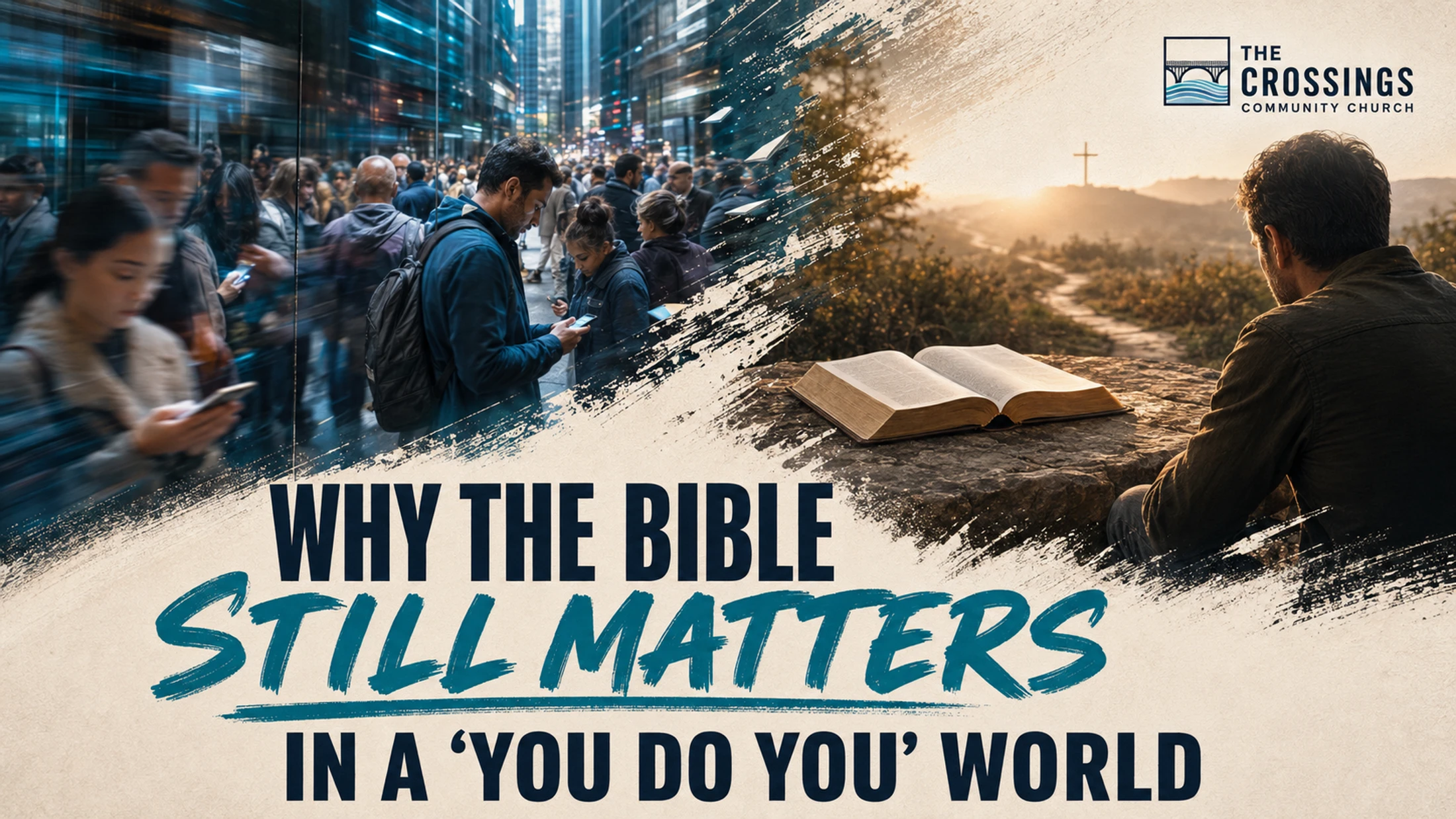
Why the Bible Still Matters in a "You Do You" World
By Rev. Justin Wyckoff
We live in a time when one of the highest cultural values sounds like this: "You do you boo!" Be your own authority. Write your own story. Decide your own truth. In that kind of world, the claim that the Bible is God's Word and carries authority over our lives can sound outdated, even dangerous.
So why should an ordinary person in Brunswick, or anywhere else in the Potomac Valley, juggling kids, bills, work, and stress, still care about an ancient book?
First, remember that the Bible is not mainly a rulebook. It is a story. From Genesis to Revelation, Scripture tells the true story of a God who creates, pursues, rescues, and will one day restore. When you open your Bible, you are not just pulling random inspirational quotes. You are stepping into the story that explains reality itself. You are seeing where the world came from, what went wrong, what God has done through Christ, and where everything is headed.
Second, the Bible has a proven track record of changing lives and cultures. For centuries, across nations, languages, and personalities, people who submit their lives to Scripture have been transformed. Slaves and slave owners, the rich and the poor, the educated and the uneducated have all been confronted, comforted, and reshaped by these words. That does not automatically "prove" inspiration, but it should make us pause. Something more than human is going on here.
Third, the Bible does not read like a book we would have written for ourselves. If we were inventing a holy book, we would probably remove the embarrassing failures of our heroes. We would tone down the hard sayings. We would center ourselves as pretty good people who just need a little improvement. Instead, Scripture exposes the sins and flaws of even its main characters. It presents God as holy and humans as deeply broken, but also deeply loved. That is not how propaganda sounds. That is how truth sounds.
What does this mean for us in a "you do you" world?
It means you do not have to understand everything in the Bible before you can trust anything. There may be passages that confuse or even disturb you. Do not let what you do not yet understand keep you from obeying what you clearly see. Walk in the light you have. Over time, more will become clear.
It also means you must read the Bible relationally. When you open Scripture, you are not doing a religious chore. You are meeting with the living God. Try asking simple questions: "What does this show me about who God is?" "What does this show me about my own heart?" "What might God be calling me to do today in response?"
Finally, it means letting God's Word challenge your "you do you." If you only agree with the Bible when it already lines up with your preferences, then you are not really submitting to God. You are just agreeing with yourself and using religious language to describe it. Let God be God. Let His voice be higher than your feelings, your politics, and your cultural moment.
In a world where everything is shifting, we need something solid. At The Crossings, we want to be people who do not just carry Bibles on Sunday, but who allow the Author of Scripture to shape our thinking, our loving, and our living every day.